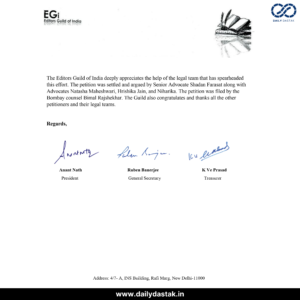

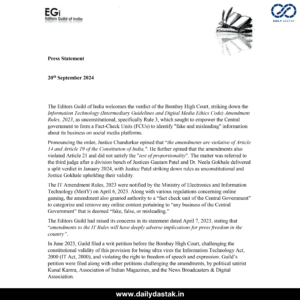
In a significant ruling, the Bombay High Court has struck down the central government’s decision to establish a Fact-Checking Unit (FCU) under the Information Technology Amendment Rules, 2023. The move follows a petition filed by stand-up comedian Kunal Kamra, who challenged the constitutionality of the new rules.
Delivering the judgment, Justice AS Chandurkar declared that the proposed amendments violated fundamental rights enshrined in Articles 14 and 19 of the Indian Constitution, which guarantee equality before the law and freedom of speech, expression, and profession. He further stated that the rules, which would have empowered the government to flag online content as “fake news,” were unconstitutional. Justice Chandurkar emphasized that vague terms such as “fake,” “false,” and “misleading” lacked clear definitions, raising concerns about their misuse.
The case was initially referred to a third judge after a split verdict by a two-judge division bench of the Bombay High Court in January. Justice Gautam Patel had ruled against the rules, calling them a form of censorship, while Justice Neela Gokhale upheld them, arguing they did not infringe upon free speech. Given the disagreement, the matter was escalated for final adjudication.
In March, the Supreme Court had temporarily stayed a government notification that sought to operationalize the Fact-Checking Unit, pending the outcome of the Bombay High Court’s ruling on the amendments’ constitutionality.
Kamra, along with other petitioners, argued that the proposed rules would lead to excessive government control over online content, effectively granting the state the authority to act as “prosecutor, judge, and executioner” in determining the truthfulness of digital information. They expressed concern that the rules could pave the way for government censorship, limiting free speech and public discourse.
The petitioners maintained that such unchecked powers over content moderation could be used to suppress dissent and legitimate criticism, raising the specter of widespread censorship under the guise of controlling misinformation.
 .
.